GOLD PROSPECTING, GOLD PANNING
EASTERN GOLD
North Carolina Gold Prospecting
South Carolina Gold Prospecting
Georgia Gold Prospecting
Virginia Gold Prospecting
Alabama Gold Prospecting
CALIFORNIA GOLD (Statewide)
(Mexican Border to Oregon state line)
Southern California Gold
Prospecting Map 1 (eastern part-adjacent to AZ and NV-Death Valley to
Yuma)
Southern
California Gold
Prospecting Map 2 (San Diego, Escondido, Santa Ana, Riverside, Palm
Springs, Salton Sea)
Southern
California Gold
Prospecting Map 3 (Ventura, Los Angeles, Lancaster, San Bernardino, Big
Bear Lake, Victorville, Barstow, Twentynine Palms)
Southern
California Gold
Prospecting Map 4 (Bakersfield, Randsburg east to Death Valley, Trona,
Porterville, Visalia, Fresno)
Northern California Gold
Prospecting Map 5 (Mother Lode- Yosemite, San Andreas, Columbia,
Sacramento, Grass Valley, Lake Tahoe, Oroville, Magalia, Downieville)
Northern California Gold
Prospecting Map 6 (N. edge of Map 5 to Oregon state line- Greenville,
Susanville, Redding, Weaverville, Trinity Center, Yreka, Happy Camp,
Crescent City)
REQUESTING GOLD
MAPS
GOLD LINKS
METAL DETECTING
RESOURCES
ANCIENT RIVERS OF
GOLD
Georgia Gold Mines, Prospecting, Panning, Treasure Hunting and Rockhounding
Georgia is one of the nation’s best states for gold prospecting, gold panning, treasure hunting and rockhounding. You will also enjoy metal detecting and treasure hunting for coins and gold nuggets in this historic gold mining state. Rockhounds who hunt for rubies and other gemstones at Franklin, North Carolina venture just a few miles south into Georgia to do prospecting and panning for gold. A good gift.
Gold mining took place continuously in Georgia from the 1820’s through l933. Have gully-washing rains, freeze-thaw cycles and other acts of nature uncovered more gold? Recreational gold panners, prospectors, treasure hunters, dredgers, divers, campers, backpackers, geologists, gold-smart natives, and recreational vehicle owners think so. Maybe you would like to try your hand at gold prospecting and panning in Georgia and its' adjoining gold-bearing states.
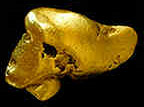 Gold Nugget - Georgia |
WHERE TO LOOK FOR AND FIND GOLD IN GEORGIA
Big Ten, Inc.'s Georgia Gold Prospecting and Panning Map shows places where to look to find gold near:
Acworth, Alpharetta, Atlanta, Auraria, Ball Ground, Blairsville, Blue Ridge, Bremen, Buchanan, Buford, Canton , Carrollton, Cartersville, Cedartown, Clarkesville, Clayton, Cleveland, Cornelia, Cumming, Dahlonega, Dallas, Dalton, Dawsonville, Decatur, Doraville, Douglasville, Duluth, Elberton, Ellijay, Gainesville, Hartwell, Helen, Hiawassee, Kennesaw, Lawrenceville, Lincolnton, Lithia Springs, Mableton, Marietta, McDonough , Monroe, Newnan, Powder Springs, Rockmart, Roswell, Royston, Smyrna, Social Circle, Stone Mountain, Tallapoosa, Tallulah Falls, Thomson, Toccoa, Tucker, Union Point, Villa Rica, Washington, Winder and Young Harris.
It shows five hundred (500) gold mines and prospecting and panning locations from official geological records of the State of Georgia and the federal government. Locations for finding gold are shown within 15 miles of each of the above listed places. These gold deposit locations, which show where gold has been found in the past, are clearly marked.
The map is done in color. The margin of the map has text that tells where to look for gold in a streambed, how to tell "fools gold" from real gold and gives step-by-step gold panning instructions. You can quickly learn to pan by following the instructions on the map.
Comments on Mining of Gold, Gold Prospecting, Gold Panning, Treasure Hunting and Rockhounding in Georgia
Among the Georgia gold mining prospecting and panning sites shown in the geological records, there are 12 sites southwest of Atlanta near Newnan, 26 gold locations just off Interstate 20 which connects Atlanta with Birmingham, 26 sites within 35 miles of Augusta, 16 sites in Rabun County near North Carolina and many sites near the Alabama and South Carolina state lines.
A band of gold mines and prospecting and panning sites runs northeast from Tallapoosa and Villa Rica. Off to the side of this streak of gold deposits, numerous gold mining, prospecting and panning sites are seen east of Athens and in the area of the Chattahoochee National Forest near Blairsville.
Georgia Gold Mining History
Portions of the following paragraphs about gold mines, gold prospecting and panning are from an article entitled "Georgia Gold" by Charles A. Overbey in Gems and Minerals magazine and is reprinted by permission of Gems and Minerals. Prior work by Robert G. Cook is acknowledged.
Gold was discovered in North Carolina in 1799; then came discoveries in South Carolina, Georgia, Alabama and Virginia. The gold-bearing strip was traced by pioneers from the North Carolina Piedmont into the Cherokee Territory. But, not until 1828 or 1829 did the major gold boom start - when news spread that gold had been discovered in North Georgia on Cherokee land.
A few months after the announcement of the discovery, hundreds of men were searching for the metal; and within a year, thousands of miners had descended into Georgia to seek the golden treasure. In 1830 a U.S. Army major described the motley appearance of the "whites, Indians, half-breeds and Negroes, boys of fourteen and old men of seventy" who sought their fortunes in the river beds and hillsides of Georgia.
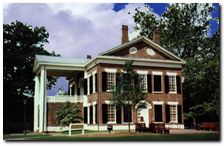 Dahlonega Gold Museum, Dahlonega, Georgia |
In 1837, the U.S. Government established a gold coin mint at Dahlonega, Georgia, about 60 miles north of Atlanta. Gold from Georgia mines and gold mines in surrounding states flowed to this mint. Private gold mints also turned out gold coins that were widely accepted in trade. Notable was the gold mint of Templeton Reid at Gainesville, Georgia. Gold coins from the Reid mint are now in great demand by collectors and command premium prices in the rare coin market, as do coins from the Dahlonega Gold Mint. Coins from the Dahlonega Gold Mint may be seen at the Dahlonega Gold Museum.
Many Georgia gold miners went west in the great California Gold Rush. On a Saturday in 1849, a crowd gathered in front of the Lumpkin County courthouse to hear Matthew F. Stephenson, assayer of the Dahlonega mint. From the balcony of the courthouse he pointed to Findley Ridge in front of him and implored the miners to stay in Dahlonega, saying "There’s millions in it." Not deterred by his entreaty, the "Forty-Niners" left for California, but they carried his words with them. Mark Twain, hearing them from a friend, William Sellers, wrote in Gilded Age his famous version of Dr. Stephenson’s expression: "There’s gold in them thar hills."
Green Russell, an Auraria, Georgia (Auraria is about 5 miles from Dahlonega) gold miner, returned from California and later, with his two brothers, led a gold party to the Kansas Territory, starting the "Pikes Peak or Bust" gold stampede that gave birth to Colorado. He helped found a small village in Colorado, naming it Auraria. It is today a part of the City of Denver.
SOME IMPORTANT GEORGIA GOLD FINDS
Gold has been reported from virtually every county in Georgia that is underlain by "chrystalline" rocks. Commercial mining was done by hydraulics, dredging and by conventional lode mining means. Individual small mining operations were carried on by panning and by use of sluice boxes.
Georgia Geologic Survey Bulletin 92, by Robert G. Cook, lists nuggets of 54, 40, and 35 troy ounces from Gilmer County; 42 and 11 ounces from Habersham County; 26, 25, 19, 18, 15, 5, 4, 3 and 2 ounces from White County; 15, 6, and 4 ounces from Lumpkin County and 4, and 3 ounces from Cherokee County. A number of interesting finds of crystalline, wire and leaf gold are also mentioned, some of which were gleaned from earlier geological documents by Yeates, McCallie and King (1896) and Jones (1909). A few of these are:
The Potosi Gold Mine, in Hall County about 11 miles northwest of Gainesville, was the source of numerous very fine examples of crystalline gold. One superb example from this location is preserved in the museum of the Georgia State Capitol.
Samples taken from the Wellborn Gold Mine in Union County contained beautifully clean, bright gold in distinct crystals and in leaf-like aggregates. An assay of this ore indicated that it contained 4.47 ounces of gold per ton.
The Loud Mine in White County produced magnificent specimens of crystallized and wire gold that were exhibited in this country and abroad.
Jones (1909) mentions a discovery of pocket gold at the Latimer Gold Mine in Wilkes County that yielded 180 troy ounces of wire and cystalline gold from 2,500 pounds of pocket material.
Several years ago interesting gold samples were found beside a spring in southeast Atlanta. The gold was in white quartz.
Outstanding specimens of native gold in quartz came from the Norrell Mine in Lumpkin County. A single pocket, at the base of what was known locally as Reservoir Hill produced approximately 700 ounces.
GEORGIA GOLD MAP
Georgia is a wonderful state for gold prospecting, gold panning, treasure hunting and rockhounding. There was a major gold rush in 1828 at Dahlonega, Georgia. Five hundred (500) Georgia gold mines and gold prospect locations are shown in 37 counties.
To request gold maps please go to REQUESTING GOLD MAPS .
Copyright © 2019 H & H Engineering. All Rights Reserved.